
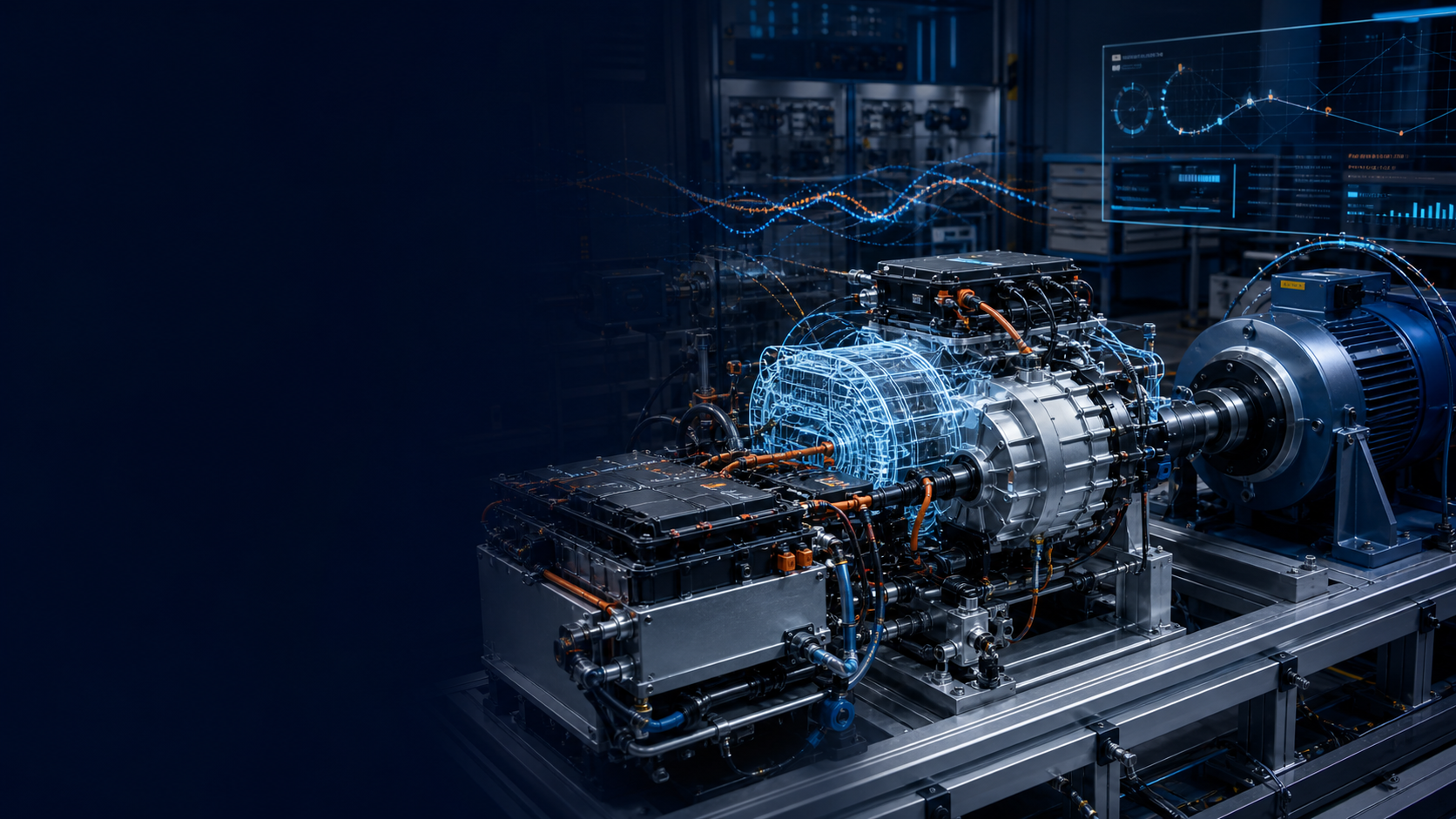
Electric Powertrains and Intelligent Mobility
Researching electric traction, model-based powertrain development, intelligent diagnostics and digital-twin technologies for more reliable, efficient and connected electric mobility.
From physical powertrains to intelligent vehicle health
The research connects electric machines, power electronics, control, sensing and data-driven intelligence across the powertrain lifecycle.
CPSE research in electric powertrains combines model-based system design with adaptable test benches to advance control, energy management, diagnostics and prognostics.
Researchers also develop distributed digital twins and experimentally validated machine-learning methods for traction-motor fault diagnosis and intelligent powertrain health management.Engineering the powertrain as an intelligent system
Select a theme to explore how physical components, engineering models, experimental data and intelligent algorithms are connected.
01
Electric Traction and Powertrain Architectures
Research considers the complete electric traction chain, including energy storage, electronic drives, electric machines and simulated vehicle dynamics, so component behavior can be evaluated as part of an integrated powertrain.
02
Model-Based Systems Engineering
MBSE and SysML organize requirements, interfaces, operating scenarios and lifecycle decisions for complex powertrain platforms. This structured approach supports traceability from system needs through design, verification and future reconfiguration.
03
Control and Energy Management
Powertrain models and adaptable test environments create a basis for developing and evaluating motor control, power-conversion and energy-management strategies under reproducible operating scenarios.
04
Fault Diagnosis and Predictive Maintenance
Vibration measurements and multi-domain signal features are used with machine-learning classifiers to distinguish healthy and faulty traction-motor conditions and support earlier maintenance decisions.
05
Digital Twins and Prognostics
Distributed digital-twin architectures connect sensor information, physical assets and intelligent models to support fault detection, diagnosis, recovery and prognostic health management in autonomous electric-vehicle powertrains.
06
Experimental Validation and Intelligent Mobility
Configurable physical benches, simulated operating conditions and real sensor data provide a pathway from algorithms to validated vehicle-health functions, supporting safer and more dependable electric mobility systems.
From electrical energy to intelligent decisions
Powertrain intelligence emerges when the physical energy-conversion chain is continuously connected to measurement, models and health decisions.
Energy Storage
Electrical energy is supplied under changing state, load and operating constraints.
Power Conversion
Inverters and electronic drives regulate energy delivered to the traction machine.
Electric Traction
The motor and drivetrain convert electrical energy into controlled vehicle motion.
Sensing and Models
Measurements and digital representations track component and system behavior.
Health Intelligence
Diagnosis and prognostics support control, maintenance and dependable mobility.
Documented platforms and validation settings
CPSE explores electric powertrains through configurable test benches, model-based engineering frameworks and experimental motor-health validation. These environments connect physical testing, digital engineering and data-driven diagnostics throughout the powertrain lifecycle.
Electric Powertrain Test Bench
A modular concept combining energy storage, two inverters and two electric machines, with one machine representing traction and the other reproducing vehicle inertia and road-load behavior.
MBSE Powertrain Architecture
A system-level framework organizes stakeholders, requirements, interfaces, operating scenarios and lifecycle needs before physical implementation and future expansion.
Traction-Motor Health Validation
Bench-mounted induction motors and real accelerometer signals are used to compare machine-learning methods across healthy, bearing-fault and static-eccentricity conditions.
A cyber-physical engineering approach
Systems Engineering
MBSE and SysML capture requirements, interfaces, use cases and lifecycle decisions.
Powertrain Modeling
Models connect energy storage, electronic drives, motors and longitudinal vehicle behavior.
Experimental Prototyping
Configurable test benches support reproducible investigation of control and health-management scenarios.
Signal Processing
Time-, frequency- and wavelet-domain features reveal patterns in vibration measurements.
Machine Learning
Classifiers and feature-reduction methods are benchmarked for motor-fault identification.
Digital-Twin Architectures
Distributed virtual representations connect physical assets, sensors and health intelligence.
Featured publications
Model-Based System Engineering Design of a Versatile Control Test Bench of an Electric Vehicle's Powertrain for Educational Purpose
An MBSE-based operational architecture for a versatile electric-traction test bench, establishing a system framework for control, diagnosis and future experimental implementation.
Explore the paper ↗Design of a Customizable Test Bench of an Electric Vehicle Powertrain for Learning Purposes Using Model-Based System Engineering
A customizable, multidisciplinary powertrain-bench design supporting physical and digital investigation of control, energy management, diagnostics and prognostics.
Explore the paper ↗Toward an Intelligent Diagnosis and Prognostic Health Management System for Autonomous Electric Vehicle Powertrains
A distributed intelligent digital-twin architecture for fault detection, diagnosis, recovery and prognostic health management across autonomous electric-vehicle powertrains.
Explore the paper ↗AI-Driven Diagnosis and Health Management of Autonomous Electric Vehicle Powertrains: An Empirical Data-Driven Approach
Real vibration measurements, multi-domain features and supervised machine learning are combined to classify induction-motor health conditions for intelligent EV monitoring.
Explore the paper ↗Where intelligent powertrain research can contribute
Electric Traction Development
System-level investigation of motors, electronic drives and drivetrain behavior.
Powertrain Control
Model-based evaluation of control and energy-management strategies under repeatable scenarios.
Predictive Maintenance
Earlier identification of degradation to improve operational continuity and maintenance planning.
Autonomous EV Reliability
Health intelligence designed to support safe, efficient and dependable autonomous powertrains.
Digital Validation
Virtual and physical representations that connect design decisions with measured system behavior.
Advanced Engineering Training
Multidisciplinary platforms linking electrical, mechanical, control and data-science expertise.